Showing posts with label culture. Show all posts

Monday, December 10, 2012

Book Review

I have recently had my book-review for Edmondson's teaming (2012) published in the Learning and Performance Quarterly online journal. LPQ is a student-led, blind peer-review journal. LPQ is an open-access publication designed to make research available to the public and to support a greater exchange of global knowledge with articles supporting innovative learning and performance across disciplines (LPQ). As a reviewer for LPQ we are looking for additional reviewers and potential editors. If anyone is interested or needs the experience of being a reviewer for their resume go the the web page and submit your name. By being an open-source publication there is no membership required,  all articles are available for reading at any time. I hope you enjoy LPQ. You can also follow LPQ on Facebook.

The book-review is listed below:


Learning and Performance Quarterly, 1(3), 2012 31 
 Book Review 
Teaming: How Organizations Learn, Innovate, and Compete in the Knowledge Economy 
Jossey-Bass; 2012; 334 Pages; ISBN: 978-0-7879-7093-2 
Introduction 
New emerging constructs found in today's literature include those referring to collaboration, complexity, and globalization. One concept that builds on each of these aforementioned constructs is teaming. Edmondson has been involved with noteworthy research in the areas of small group and team research, including that of team psychological safety. Team psychological safety represents a climate in which group and/or team members feel comfortable questioning other's ideas, feel comfortable being challenged to defend one's own point of view, and are more open to constructive criticism. In her research, Edmondson identified psychological safety as a team construct in which a psychological safety measurement was developed showing that psychological safety affects learning behavior and also team performance. In her recent book, teaming, team psychological safety is but one construct identifying the learning construct teaming. 
Teaming 
Edmondson stated that “teaming is teamwork on the fly” (p. 13). Teams are traditionally portrayed in the literature as being a noun, consisting of fixed groups in pursuit of a common goal. Edmondson changes the discussion by placing teams as a verb, representing a dynamic activity, determined by the mindset and practices of teamwork. In Edmondson’s foundation for learning model, teaming is the first foundation, representing the structural support required for all other activities to take place. Edmondson identified four behaviors to accompany the foundation of teaming: speaking up, experimentation, collaboration, and reflection, 
Organizing to Learn 
Teaming is further differentiated from recent literature in that teaming is an organizational learning model. Edmondson’s model puts teaming as the driver for successful organizational learning functions. While teaming provides an environment for learning, Organizing to Learn, the second foundation for Edmondson’s learning model, promotes collective learning. Collective learning includes the following individual learning behaviors: a) asking questions, b) sharing information, c) seeking help, d) experimenting with unproven actions, e) talking about mistakes, and f) seeking feedback (p. 27). Edmondson identified the following four steps for the foundation organizing to learn: framing for learning (mental maps), creating psychological safety, learning from failure, and reaching across boundaries. 
Execution-as-Learning 
The third and final foundation in Edmondson’s foundation for learning model was Execution-as-Learning, paralleling the same idea as that of action learning. Action learning follows four general principles, a) learning is acquired by doing, b) participants address organizational problems as well as personal development, c) participants work in Learning and Performance Quarterly, 1(3), 2012 32 
teams with peers, and d) participants follow an attitude of learning-to-learn. Execution-as-Learning was best described by Edmondson as the place in which "action and reflection go hand in hand” (p. 222). Four steps were included in Edmondson’s foundation for learning model to represent the foundation Execution-as-Learning: diagnose, design, act, and reflect. 
Conclusion 
Together, these three foundations structure a learning environment (teaming) functioning on collective learning principles (Organizing to Learn) in which problems are addressed through systematic action learning steps (Execution-as-Learning). In Edmondson’s model a heavy emphasis was placed on leadership, which is required to get the process rolling. This heavy emphasis on leadership could be viewed as a weakness if an organization does not have a supportive leader. Edmondson indicated that leadership is what makes the process work, tying the foundations together. Successful teaming and learning thrive when leadership is able to focus on the foundations for learning, thus creating the by-product of a learning culture. Teaming is about more than just teams and their internal interactions. Teaming becomes the building block for a learning organization, which is the strength of Edmondson’s book. 
John R. Turner is currently a doctoral student in the Applied Technology & Performance Improvement (ATPI) program at the University of North Texas. His background is in engineering, with a second bachelor’s degree in Psychology from the University of Arkansas at Little Rock and a Master’s degree in Human Resource Development (HRD) from the University of Texas at Tyler. His research interests include performance improvement, team performance, team cognition, cognition/metacognition, outcomes-based evaluation, and meta-analysis techniques, and he has published in Performance Improvement and Journal of Knowledge Management. 


Tuesday, August 7, 2012

Incorporate a Mindfulness Culture


Weick and Sutcliffe (2007), in their book Managing the Unexpected,  identified that it is one's expectations that can get a team, group, or department into trouble. Expectations work well for predicting planned change and for setting future goals. However, these are only perceived states. Expectations never go as planned. The difference between one's expectation and what actually occurs is what Weick and Sutcliffe (2007) identified as the blind spot. To counter these unexpected events from occurring, the blind spot, organizations need to develop a more mindful culture, termed mindfulness (Weick & Sutcliffe, 2007): "This enriched awareness, which we call mindfulness, uncovers early signs that expectations are inadequate, that unexpected events are unfolding, and that recovery needs to be implemented" (p. 23).

Being mindful includes a culture where employees are able to notice the unexpected, to update plausible interpretations continuously, and to identify potential problems and remedies (Weick & Sutcliffe, 2007). Five common keys to incorporating a mindful infrastructure were outlined by Weick and Sutcliffe (2007):
  • Principle 1: Preoccupation with Failure.
  • Principle 2: Reluctance to Simplify.
  • Principle 3: Sensitivity to Operations.
  • Principle 4: Commitment to Resilience.
  • Principle 5: Deference to Expertise (pp. 9 - 15).

Incorporating your team, unit, department, or organization into a mindful infrastructure takes time. One way to begin this phase is to start with small wins. Small wins that move people from a mindless culture to a mindful culture start with the following steps outlined by Weick and Sutcliffe (2007):
  • Remember that mindfulness takes effort.
  • Offer support to people who are making an effort to become more mindful.
  • Frame mindfulness in novel ways.
  • Mitigate complacency.
  • Remember that reliability is not bankable.
  • Carry your expectations lightly.
  • Balance centralization with decentralization.
  • Let culture do the controlling (pp. 148 - 150).

Having the capability to recognize problems when they occur and the ability to react to these problems will help reduce the amount of down time due to unexpected events.  As stated by Weick and Sutcliffe (2007): "We find failures of expectations everywhere, which is why managing the unexpected is so crucial" (p. 21).

References:
Weick, K. E., & Sutcliffe, K. M. (2007). Managing the Uunexpected: Resilient Performance in an Age of Uncertainty (2nd ed.). San Francisco, CA: Jossey-Bass.

Friday, July 13, 2012

Activity Theory, Expansive Learning Cycle


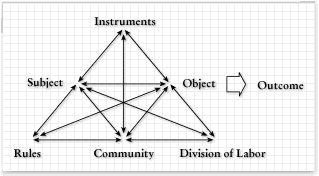
Activity theory addresses learning activities that take place in a complex environment (non-linear, dynamic, heterogeneous) as opposed to a linear learning environment (homogenous, static, instructional). In the following diagram the subject interacts with the object mediated by various influences from the environment; instruments, division of labor, community, and rules (Engerstom, 2001).


File:Activity-theory.gif

Retrieved from: http://edutechwiki.unige.ch/en/File:Activity-theory.gif


When viewing theories Engerstom (2001) poised that any theory must answer the following four questions:
  1. Who are the subjects of learning, how are they defined and located?;
  2. When do they learn, what makes them make the effort?;
  3. What do they learn, what are the contents and outcomes of learning?;
  4. How do they learn, what are the key actions or processes of learning? (P. 133).

It is from activity theory that Engersom (2001) derived the Cycle of Expansive Learning. This cycle could be viewed as an extension of 
Shewart's Plan-Do-Check-Act cycle (McLean 2006, p. 19) and Lewin's planned approach to change. Both of these change theories are identified under the action research literature. 

Engerstom's cycle of expansive learning is shown in the following figure:


Figure Retrieved from: http://edutechwiki.unige.ch/en/File:Expansive-learning.png

In this expansive learning cycle the following steps are followed:
  1. Charting the Situation
    • Something must be done.
    • Commitment to change.
  2. Analyzing the Situation
    • How did we work in the past (history)?
    • What are our present troubles and contradictions?
  3. Creating a new Model/Vision
    • How do we want to work in the future?
  4. Concretizing and Testing the new Model
    • What changes do we want to try next month?
  5. Implementing the new Model
    • Putting into practice the first steps.
    • Pushing for the next steps.
  6. Spreading and Consolidating
    • Teaching others what we learned (knowledge distribution)
    • Codifying the new rules, etc.
    • Permanent reflection (Weber, 2008, p. 53).

Activity theory focuses more on cultural theory while action research focus more on conducting research in natural settings. In either case, there are similarities in the various change models from both schools of theory. Diversifying one's knowledge base can only be productive in allowing one to view change models from different perspectives, resulting in more productive results.

References:

Engestrom, Y. (2001). Expansive learning at work: toward an activity theoretical reconceptualization. Journal of Education and Work, 14, 133-156. doi: 10.1080/13639080020028747

McLean, G. N. (2006). Organization Development: Principles, Processes, Performance. San Francisco, CA: Berrtt-Koehler.

Weber, S. (2008). Intercultural learning in business and human resource education. In Nijhof, W. J., & Nieuwenhuis, L. F. M. (ads.), The Learning Potential of the Workplace, 47-69. Rotterdam, Netherlands: Senge.


Friday, June 22, 2012

Organizational Culture and Change


Meyerson and Martin (1987) view organizations as cultures in which organizational change incorporates "changes in patterns of behavior, values, and meanings (p. 624). From their research, Meyerson and Martin (1987) identified three paradigms of organizational culture: integration, differentiation, and ambiguity.

Paradigm 1: Integration

Integration views of organizational culture identifies with those views that are shared: "for example, a common language, shared values, or an agreed-upon set of appropriate behaviors" (Meyerson & Martin, 1987, p. 624). Through an exhaustive search of cultural studies and theories, Meyerson and Martin (1987) identified three common characteristics for integration cultural theories: "consistency across cultural manifestations, consensus among cultural members, and -usually- a focus on leaders as culture creators" (p. 625). An integration culture would be found in most organizations that operate in a traditional top-down, controllable, manner.

Paradigm 2: Differentiation

Differentiation theories of organizational culture espouse diversity, where attention is paid to "inconsistencies, lack of consensus, and non-leader-centered sources of cultural content" (Meyerson & Martin, 1987, p. 630). Where an integrated culture is more closed, a differentiation culture is more open, influenced from both inside and outside influences (Meyerson & Martin, 1987). A differentiation culture would be found in organizations that operate with a flat or horizontal hierarchy, allowing more decisions to be made from front-line employees.

Paradigm 3: Ambiguity

Where paradigm 1, integration, resists ambiguity due to its rigidity, paradigm 2, differentiation, is more open to ambiguity so that it can be managed. For paradigm 3, ambiguity is accepted as "the way things are, as the 'truth', not as a temporary state awaiting the discovery of 'truth'" (Meyerson & Martin, 1987, p. 637). An ambiguity culture would be found in organizations that operate on a network theory or a complexity theory model.

Organizations address culture differently, partly based on the type of environment they operate in. Weick and Sutcliffe (2007) recommended to make your organization as complex as the environment - the more complex the environment, the more complex the organizational system will need to be in order to function accordingly. 

No one organization operates completely in one paradigm, there are usually portions of each type of paradigm present in any organization. When addressing change, it is recommended to view the change effort from each of the three paradigms rather than solely from one paradigm. As Meyerson and Martin (1987) pointed out: "An awareness of all three paradigms simultaneously would avoid the usual blind spots associated with any single perspective" (p. 643).

References:

Meyerson, D., & Martin, J. (1987). Cultural change: An integration of three different views. Journal of Management Studies, 24(6), 623-647. Retrieved from http://onlinelibrary.wiley.com/journal/10.1111/(ISSN)1467-6486

Weick, K. E., & Sutcliffe, K. M. (2007). Managing The Unexpected: Resilient Performance in an Age of Uncertainty. San Francisco, CA: Jossey-Bass.

Related Posts Plugin for WordPress, Blogger...