Showing posts with label workplace learning. Show all posts

Friday, July 13, 2012

Activity Theory, Expansive Learning Cycle


Activity theory addresses learning activities that take place in a complex environment (non-linear, dynamic, heterogeneous) as opposed to a linear learning environment (homogenous, static, instructional). In the following diagram the subject interacts with the object mediated by various influences from the environment; instruments, division of labor, community, and rules (Engerstom, 2001).
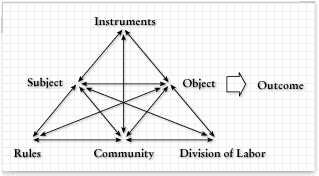

File:Activity-theory.gif

Retrieved from: http://edutechwiki.unige.ch/en/File:Activity-theory.gif


When viewing theories Engerstom (2001) poised that any theory must answer the following four questions:
  1. Who are the subjects of learning, how are they defined and located?;
  2. When do they learn, what makes them make the effort?;
  3. What do they learn, what are the contents and outcomes of learning?;
  4. How do they learn, what are the key actions or processes of learning? (P. 133).

It is from activity theory that Engersom (2001) derived the Cycle of Expansive Learning. This cycle could be viewed as an extension of 
Shewart's Plan-Do-Check-Act cycle (McLean 2006, p. 19) and Lewin's planned approach to change. Both of these change theories are identified under the action research literature. 

Engerstom's cycle of expansive learning is shown in the following figure:


Figure Retrieved from: http://edutechwiki.unige.ch/en/File:Expansive-learning.png

In this expansive learning cycle the following steps are followed:
  1. Charting the Situation
    • Something must be done.
    • Commitment to change.
  2. Analyzing the Situation
    • How did we work in the past (history)?
    • What are our present troubles and contradictions?
  3. Creating a new Model/Vision
    • How do we want to work in the future?
  4. Concretizing and Testing the new Model
    • What changes do we want to try next month?
  5. Implementing the new Model
    • Putting into practice the first steps.
    • Pushing for the next steps.
  6. Spreading and Consolidating
    • Teaching others what we learned (knowledge distribution)
    • Codifying the new rules, etc.
    • Permanent reflection (Weber, 2008, p. 53).

Activity theory focuses more on cultural theory while action research focus more on conducting research in natural settings. In either case, there are similarities in the various change models from both schools of theory. Diversifying one's knowledge base can only be productive in allowing one to view change models from different perspectives, resulting in more productive results.

References:

Engestrom, Y. (2001). Expansive learning at work: toward an activity theoretical reconceptualization. Journal of Education and Work, 14, 133-156. doi: 10.1080/13639080020028747

McLean, G. N. (2006). Organization Development: Principles, Processes, Performance. San Francisco, CA: Berrtt-Koehler.

Weber, S. (2008). Intercultural learning in business and human resource education. In Nijhof, W. J., & Nieuwenhuis, L. F. M. (ads.), The Learning Potential of the Workplace, 47-69. Rotterdam, Netherlands: Senge.


Thursday, August 18, 2011

Is Your Workplace Designed for Learning?

As the 21st century transitions to the knowledge worker (from the industrial / manufacturing worker of the 20th century & from the agricultural worker from the 19th century) companies are faced with the responsibility of training their workers to acquire the required knowledge, skills, and abilities (KSA’s) for their jobs. Nijhof and Nieuwenhuis (2008) identified that work is shifting toward knowledge-intensive work, with a focus on knowledge production. It is not uncommon today to view a journal article or a newsletter that talks about the knowledge-economy. The primary difference here is that knowledge-economy refers more to a macro perspective, where knowledge production looks more at a micro perspective.

As the requirements for the knowledge worker continually changes to keep up with the global economy and new technologies, the educational system often falls behind these new technologies, thus furthering the burden for the employer to train employees. This new emphasis on training, by the employer, was highlighted by Nijhof and Nieuwenhuis (2008) by stating: “Efficient and effective learning impose requirements on workplaces that are different from those for efficient and effective working” (pp. 6-7). This new requirement on employers causes a shift in the common practices of the organization.

Most views of the workplace take the stand that there is a place to work (the workplace), there is a place to play (at home), and there is a place to learn (at home or at school – both away from the workplace). However, learning new tasks or skills are often required to perform one’s job. Alternatively, in order to successfully perform one’s job, one must be able to learn about the job duties and processes that are involved with that particular job. Nijhof & Nieuwenhius (2008) identified that learning is an intermediate function of work, “the learning potential of the workplace therefore lies in its conditions to support or stimulate learning” (Nijhof & Nieuwenhuis, 2008, p. 5). Thus, the more learning is supported in the workplace, employees have a tendency to be more motivated and productive.

A fully supported learning environment in the workplace could be replicated using the following definition provided by Nijhof and Nieuwenhuis (2008): “The learning potential of the workplace may… be defined as the power of a work setting to integrate learning at work with the result of behavioural changes and the generation of new knowledge” (p. 7).

Is your organization set up to integrate learning in the workplace? I will follow up in the next couple of blogs with a few models that could be implemented to begin a new learning workplace for organizations.

References

Nijhof, W. J. & Nieuwenhuis, L. F. M. (2008). The learning potential of the workforce. In Nijhof, W. J. & Nieuwenhuis, L. F. M. (Eds.), The learning potential of the workplace. Rotterdam, The Netherlands: Sense.

Related Posts Plugin for WordPress, Blogger...